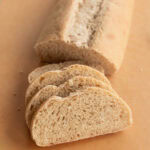
Fresh Milled Flour French Bread Recipe
Fresh Milled Flour French Bread made with hard white wheat, perfect with dinner, as garlic bread, French bread pizza, breadcrumbs, and more!
Servings: 24 slices
Calories: 96kcal
Ingredients
Fresh Milled Flour French Bread
- 600 g hard white wheat berries mill a little extra for shaping
- 408-428 g water lukewarm
- 13 g honey
- 19 g olive oil
- 11 g fine salt
- 7 g instant yeast
Egg Wash
- 1 large egg
- 1-2 tablespoons water
Instructions
Fresh Milled Flour French Bread
- Mill the hard white wheat berries as finely as possible. Reweigh the freshly milled flour and make sure you have 600 g.600 g hard white wheat berries
- Add the flour, 408-428 g lukewarm water, and honey to the bowl of a stand mixer. Mix until all of the flour is incorporated.408-428 g water, 13 g honey
- Cover the bowl and let the flour hydrate for 30 minutes.
- Add the olive oil, salt, and instant yeast. Knead on speed 2 until the dough reaches the windowpane stage. If the mixer gets too warm, stop and let it rest before continuing. This should be 8-12 minutes in most stand mixers, longer in an Ankarsrum.19 g olive oil, 11 g fine salt, 7 g instant yeast
- Transfer the dough to a lightly oiled bowl, or lightly oil your hands, form it into a ball, and place it in the bowl. Cover and let rise until doubled in size, about an hour. About an hour.
- Prepare a baking sheet with parchment paper cut into two pieces. You can also use a French Bread or Italian loaf pan.
- Turn the dough onto a very lightly floured work surface and divide it into 2 equal portions. I use a scale for this.
- Work with one piece at a time, gently pressing or rolling the dough into a rectangle.
- Starting from one long edge, roll the dough up snugly into a log. Press out any obvious large air pockets as you roll, and use the heel of your hand to "seal" as you roll.
- Brush away any loose flour from the final edge. Firmly pinch the seam closed to seal the dough.
- Place the loaf seam side down. Gently roll with your hands only as needed to even out the loaf and slightly taper the ends if desired.
- Repeat with the remaining piece of dough.
- Place the loaves on a parchment lined baking sheet with space between them.
- Cover the loaves with a proofing lid, dome, or plastic wrap, ensuring it does not touch the dough.
- Let the loaves rise until very puffy and noticeably proofed and increased in size; doubling isn't necessary, but check proofing with a gentle poke. It should slowly spring back and leave a slight indentation. This takes about 60-90 minutes depending on room temperature.
- Preheat the oven to 375°F during the last 20–30 minutes of the second rise.
- Score the loaves; make 1 long score down the length of the loaf.
Egg Wash
- Whisk the egg with 15-30 g water until completely combined.1 large egg, 1-2 tablespoons water
- Brush a very thin layer of egg wash over the surface of each loaf, avoiding the scored area.
- Bake at 375°F for 20-22 minutes. Start checking early as loaf thickness and oven temp can vary.
- Continue baking until the loaves are golden and the centers reach about 195°F.
- Transfer the loaves to a wire rack and cool completely before slicing.
Video
Notes
- Hydration: Use 408 g water (68%) for a softer, tighter crumb, or up to 428 g (71%) for a chewier, more open crumb.
- Scoring: Make one long, straight-down score for a wide bloom with no blowout, or slight diagonal scores for more height with some blowout along the side.
- Flour: Reweigh the flour after milling to confirm you have exactly 600 g.
- Autolyze: Let the flour, water, and honey rest for the full 30 minutes before adding the remaining ingredients.
- Windowpane: Knead until the dough reaches a good windowpane.
- Shaping: Use only a light dusting of flour on the work surface. Too much flour can dry the dough and make the seam harder to seal. Brush away any loose flour before pinching the final seam closed.
- Proofing: Keep the shaped loaves covered during the second rise so the surface stays soft and supple.
- Egg Wash: Score the loaves first, then brush the egg wash only onto the unscored surface. Avoid getting egg wash inside the score marks.
- Storage: Store completely cooled bread at room temperature in a bread bag or airtight container for 2-3 days. Freeze well wrapped for up to 3 months.
Nutrition
Serving: 1slice | Calories: 96kcal | Carbohydrates: 18g | Protein: 4g | Fat: 1g | Saturated Fat: 0.2g | Polyunsaturated Fat: 0.1g | Monounsaturated Fat: 1g | Trans Fat: 0.001g | Cholesterol: 7mg | Sodium: 181mg | Potassium: 6mg | Fiber: 3g | Sugar: 0.5g | Vitamin A: 10IU | Vitamin C: 0.003mg | Calcium: 13mg | Iron: 1mg